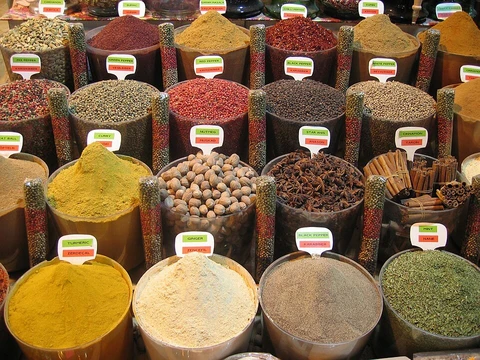
Turmeric
A rhizomatous plant used as spice, dye, and in traditional medicine.

Turmeric (Curcuma longa) is a flowering plant in the ginger family Zingiberaceae, native to the Indian subcontinent and Southeast Asia. It is a perennial, rhizomatous herb that requires temperatures between 20 and 30 °C and high annual rainfall, and its rhizomes are gathered yearly for propagation, consumption, or dyeing.
- Scientific name
- Curcuma longa
- Family
- Zingiberaceae
- Native region
- Indian subcontinent and Southeast Asia
- Height
- Up to 1 m (3 ft 3 in)
- Key compound
- Curcumin
- Culinary use
- Coloring and flavoring agent in Asian cuisines
- Historical use
- Dye, folk medicine, and ritual
Lore & Background
Turmeric has been used in Asia for centuries, first as a dye and later in folk medicine. It is a major part of Ayurveda, Siddha medicine, traditional Chinese medicine, Unani, and Austronesian animistic rituals. In India, it spread with Hinduism and Buddhism, where the yellow dye colors monks' and priests' robes. In Maritime Southeast Asia, linguistic evidence suggests ancient use among Austronesian peoples soon after dispersal from Taiwan, before contact with India. Turmeric was also carried by the Lapita people into Oceania, reaching as far as Hawaii and Easter Island, and was an important trade item in the sawei maritime exchange between Yap and the Carolines.
Reader's Guide
Turmeric is significant as a key ingredient in many Asian dishes, imparting a mustard-like, earthy aroma and pungent, slightly bitter flavor. It is used fresh or dried and ground into a deep orange-yellow powder, a principal component of curry powders. Despite long use in Ayurvedic medicine, there is no high-quality clinical evidence that turmeric or its constituent curcumin is effective for treating any disease. Curcumin is approved as a food additive by the World Health Organization, European Union, and United States Food and Drug Administration. Turmeric and curcumin are generally safe but have been linked to rare cases of immune-mediated acute liver injury, especially in high-bioavailability forms, which typically resolve after stopping use. The taxonomy of Curcuma longa is problematic, with only specimens from South India identifiable as C. longa; other species sold as turmeric in Asia belong to similar taxa with overlapping local names.
Did You Know?
- In Medieval Europe, turmeric was called 'Indian saffron.'
- The name possibly derives from Middle English 'turmeryte' or Latin 'terra merita' (deserved earth).
- Turmeric can only be propagated with rhizomes, so its pre-contact distribution into Pacific Islands was via human introduction.
Frequently Asked Questions
Who is Turmeric?
Turmeric is a perennial, rhizomatous flowering plant in the ginger family (Zingiberaceae), scientifically named Curcuma longa. It is indigenous to the Indian subcontinent and Southeast Asia and can grow up to roughly one meter tall.
What are Turmeric's powers and role?
Its rhizomes are prized as a coloring and flavoring staple across many Asian cuisines, while also serving as a natural dye and a long-standing ingredient in traditional medicine. The compound curcumin is the active molecule responsible for its distinctive properties.
How does Turmeric's story end?
Because Turmeric is a perennial, it never truly exits the cast; each year its underground rhizomes are dug up for propagation, cooking, or dyeing, and new shoots sprout the following season. The cycle repeats as long as it receives 20–30 °C warmth and abundant rainfall.
Why is Turmeric important?
It anchors a huge range of regional cooking, healing traditions, and textile-dyeing practices across South and Southeast Asia. Its signature compound, curcumin, has made it a focal point of both culinary culture and botanical research.
What are Turmeric's basic stats?
Scientific name: Curcuma longa. Family: Zingiberaceae. Native range: Indian subcontinent and Southeast Asia, with a maximum height of about one meter (3 ft 3 in) and a need for a hot, wet climate to thrive.
More in Herbs And Spices 1-15
Spotted an error? Know more?
This is a living reference — every entry is fact-audited, and reader corrections feed straight into our audit queue. Suggest an edit · See this site's audit record