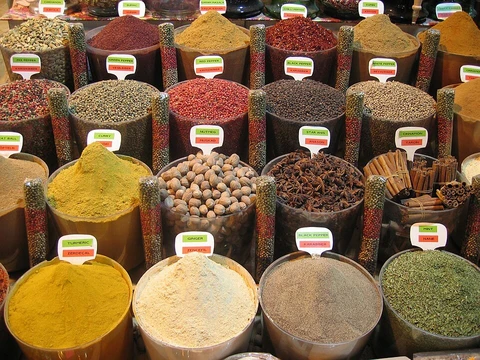
Liquorice
A flowering plant whose root yields a sweet flavouring used worldwide.

Liquorice (Commonwealth English) or licorice (American English) is the common name of Glycyrrhiza glabra, a flowering plant of the bean family Fabaceae. From its root, a sweet, aromatic flavouring is extracted, used in confectionery, tobacco, beverages, and pharmaceuticals, and marketed as a dietary supplement. The plant is an herbaceous perennial legume native to West Asia, Tropical Asia, North Africa, and Southern Europe.
- Scientific name
- Glycyrrhiza glabra
- Family
- Fabaceae
- Native regions
- West Asia, Tropical Asia, North Africa, Southern Europe
- Height
- Up to 1 metre (40 in)
- Key compound
- Glycyrrhizin (7–10% of root)
- Sweetness relative to sugar
- 30–50 times sweeter
- Countries producing
- Turkey, Greece, Iran, Iraq
Lore & Background
The word liquorice derives via Anglo-French from Late Latin liquiritia, ultimately from Greek γλυκύρριζα (glykyrrhiza), meaning 'sweet root'. The species name glabra means 'smooth', referring to the plant's smooth husks. The plant grows to 1 metre tall, with pinnate leaves 7–15 cm long, purple to pale whitish blue flowers, and stoloniferous roots. Liquorice root contains triterpenoids, polyphenols, and polysaccharides; its yellow colour comes from flavonoids. The principal glycoside, glycyrrhizin, accounts for 7% to 10% of the root's content. The scent includes anethole (about 3% of total volatiles).
Reader's Guide
Liquorice is significant as a flavouring agent in confectionery, tobacco, beverages, and pharmaceuticals, and has a long history in herbalism and traditional medicine. In traditional Chinese medicine, a related species (G. uralensis) is used to harmonize formulas, though no high-quality clinical research indicates safety or efficacy for any medicinal purpose. Excessive consumption (more than 2 mg/kg per day of pure glycyrrhizinic acid) can lead to hypertension, hypokalemia, and muscle weakness. The US FDA regards liquorice as generally recognized as safe if not consumed excessively. Liquorice is used in a wide variety of candies, drinks (such as Egypt's Erq sous), and tobacco products.
Did You Know?
- The word 'liquorice' derives from Greek γλυκύρριζα, meaning 'sweet root'.
- Glycyrrhizin, the main sweet compound, is 30–50 times sweeter than sugar.
- Excessive consumption can cause hypertension, low blood potassium, and muscle weakness.
- In the Netherlands, liquorice confectionery is often mixed with ammonium chloride to make 'salty liquorice' (zoute drop).
Frequently Asked Questions
What is Liquorice?
Liquorice is the common name for Glycyrrhiza glabra, a perennial flowering legume in the bean family (Fabaceae). Its root is harvested to produce a sweet, aromatic extract that flavours confectionery, beverages, tobacco, and medicines around the world.
Where does Liquorice grow natively?
The plant is indigenous to West Asia, Tropical Asia, North Africa, and Southern Europe. As an herbaceous perennial, it typically reaches up to one metre (about 40 inches) in height.
Why is Liquorice so much sweeter than sugar?
The root contains a compound called glycyrrhizin, which accounts for roughly 7–10% of the dried material. This substance is estimated to be 30 to 50 times sweeter than ordinary table sugar, giving the extract its signature intense sweetness.
What is Liquorice actually used for?
The extracted flavouring is a staple in confectionery, tobacco products, and various beverages. It also features in pharmaceutical preparations and is sold as a dietary supplement.
What family does Liquorice belong to?
It is classified in Fabaceae, the legume or bean family, making it a flowering perennial legume rather than a true culinary herb. This places it in the same botanical group as peas, lentils, and clover.
More in Herbs And Spices 1-15
Spotted an error? Know more?
This is a living reference — every entry is fact-audited, and reader corrections feed straight into our audit queue. Suggest an edit · See this site's audit record